





CS tools shouldn't alert you. They should act
One system for sales, onboarding, CS, and expansion. CS runs on leading signals like sentiment shifts, stakeholder changes, and expansion openings, surfaced while there's still time to act.
Book a demo
AI that actually understands B2B
software retention
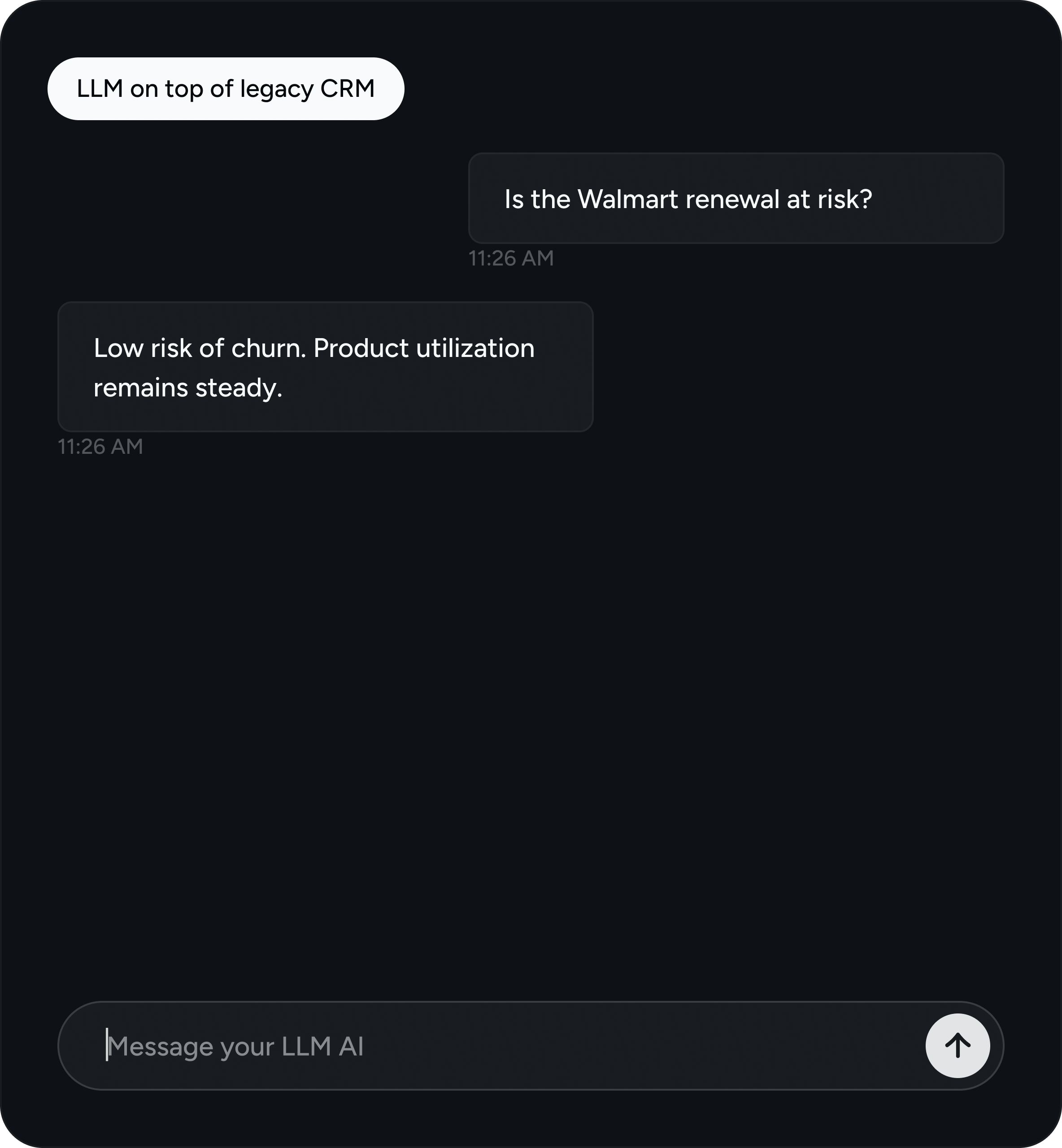
Every CS platform now claims to predict churn. Most run a manually weighted scorecard with a generic LLM that doesn't really understand B2B software retention challenges.
Dreamhub's AI is tuned only for B2B software and trained on what actually drives retention.

Deep insights protect renewals and
drive expansion

A CS platform that does the work, not just the alerts
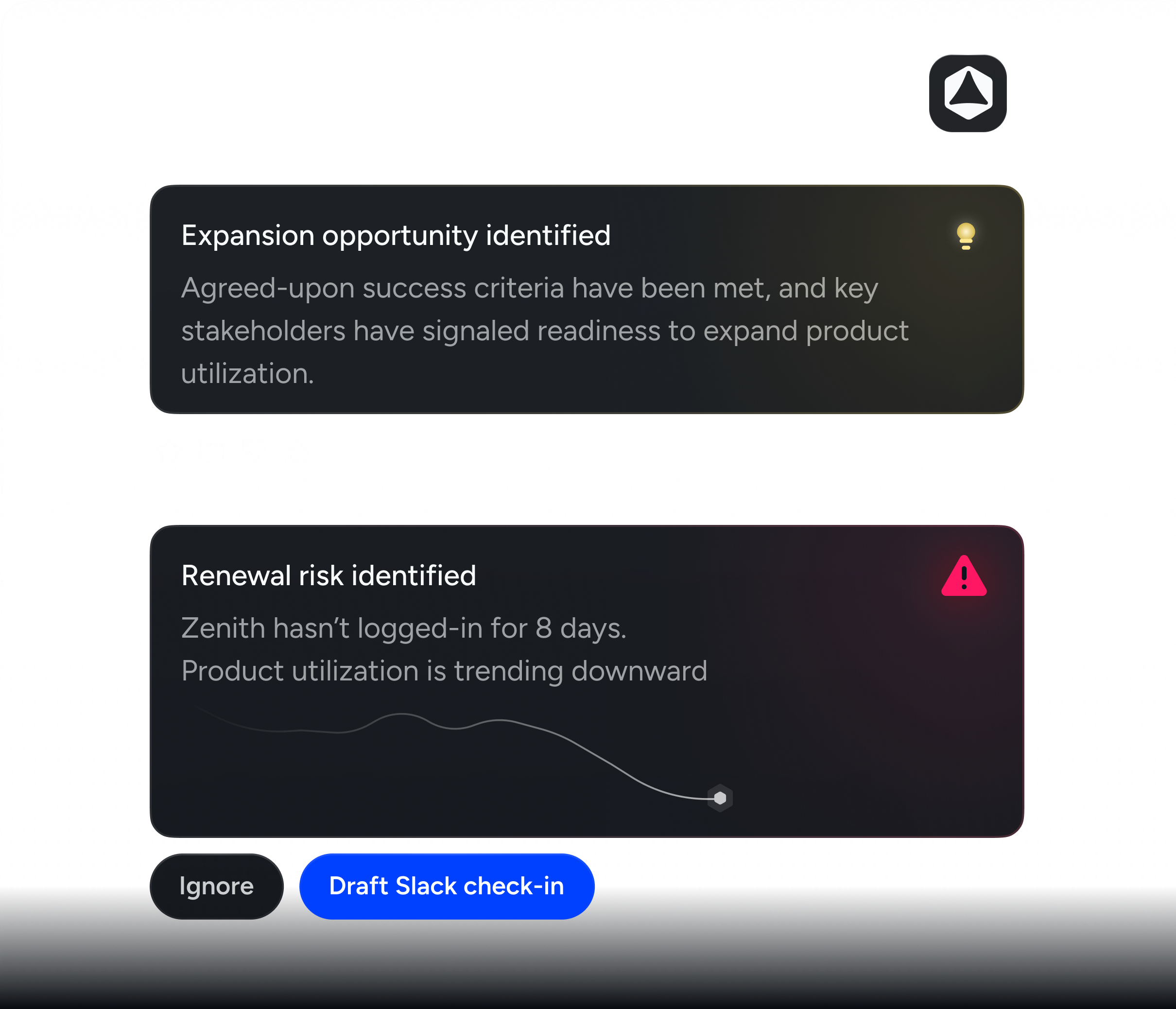
Other tools tell you an account is at risk. Dreamhub tells you the account is at risk and then drafts the outreach, fires the save play, and updates the record automatically.

Cut 90% of manual CSM work
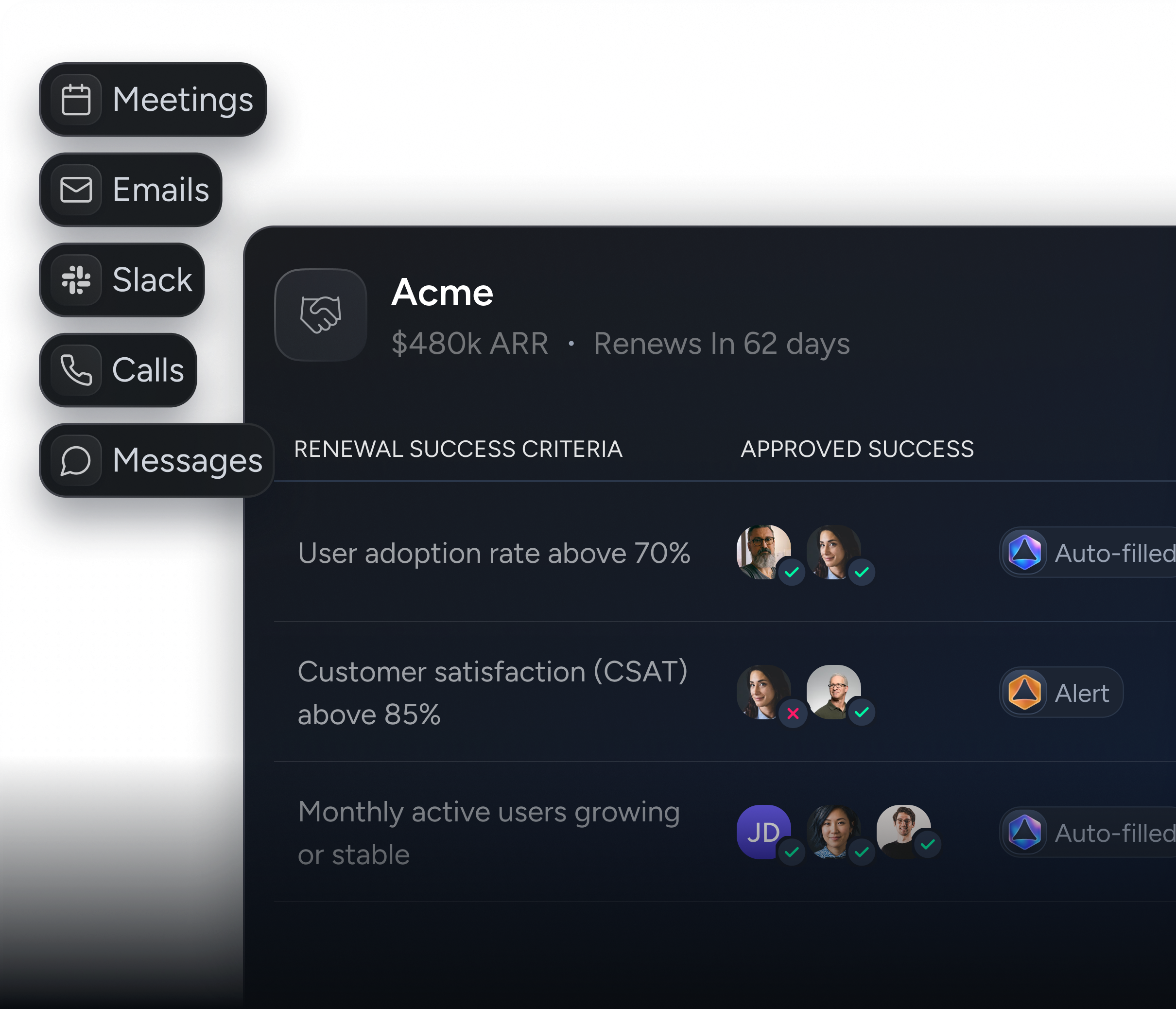
Imagine every CSM carrying 50% more accounts. Calls, emails, and meetings are analyzed automatically so Dreamhub updates health scores, keeps the stakeholder map current, captures success criteria, and drafts outreach.
Insights become outcomes, automatically
Dreamhub doesn't stop at insights, it executes. Detected churn risks fire save plays, expansion signals trigger outreach, QBRs auto-assemble from real data. Insights become outcomes automatically, so CSMs don't have to.
Renewal calls Dreamhub helps you win
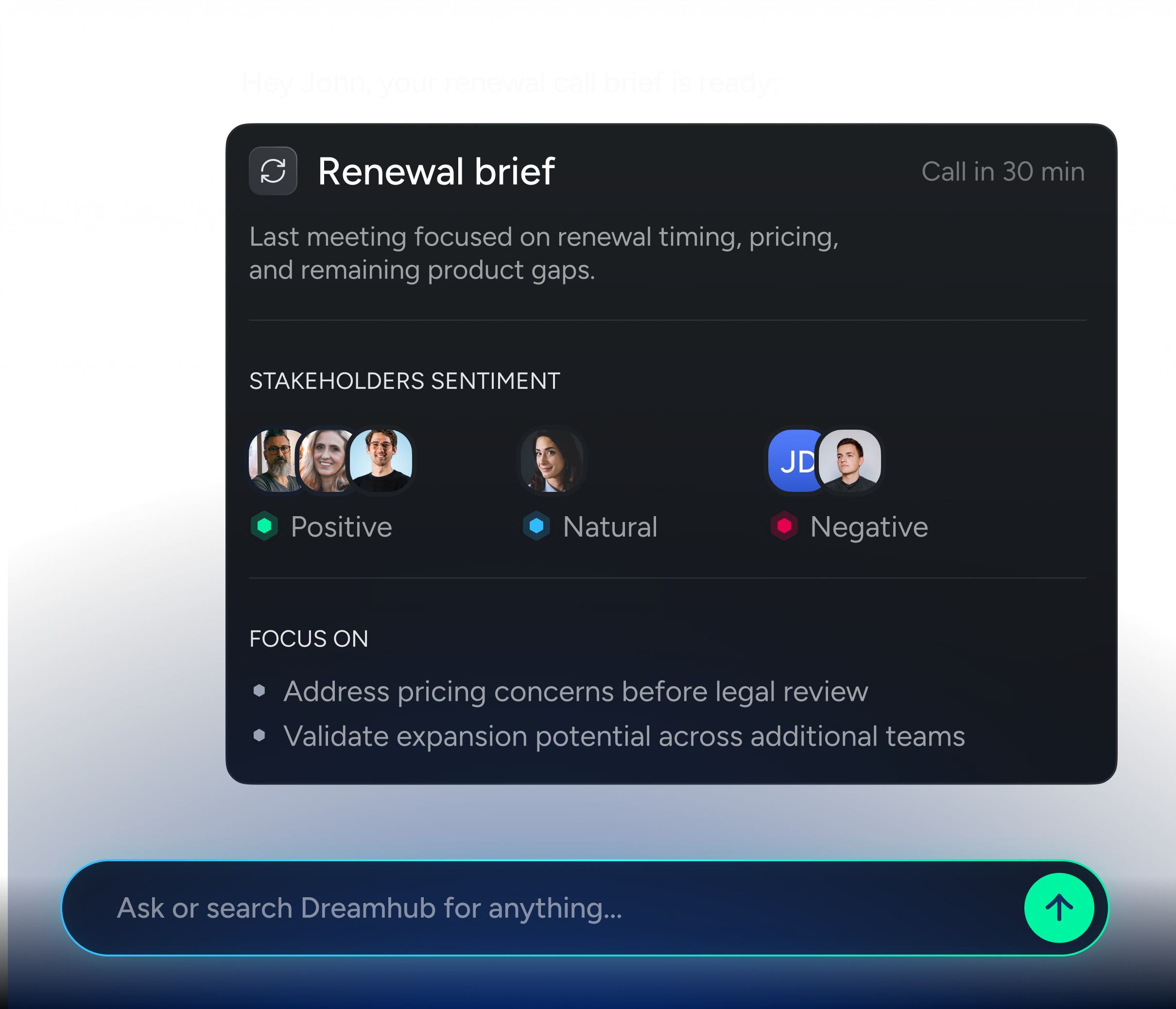
For every renewal, Dreamhub builds the play: the talking points, the objections to expect, the expansion angle, the reference accounts. The CSM walks in coached, not winging it.

Migration that isn't a nightmare.
Go live in a few days.
| Capability | Dreamhub | Gainsight | Totango | ChurnZero |
|---|---|---|---|---|
| AI tuned for B2B software retention | AI-native CS intelligence trained on B2B software retention, expansion, onboarding, and stakeholder signals | Generic CS AI layered onto a horizontal customer success platform | Generic CS AI layered onto configurable customer success workflows | Generic CS AI layered onto health scoring and playbook tooling |
| Lifecycle coverage | Sales, onboarding, CS, renewal, and expansion on one shared revenue model | CS-only platform that depends on CRM integrations for sales context | CS-only platform that depends on CRM integrations for sales context | CS-only platform that depends on CRM integrations for sales context |
| Insight to action | Detected risks trigger save plays, draft outreach, update records, and guide the next step automatically | Surfaces risk and recommendations; execution still depends on CSM workflow setup | Surfaces risk and recommendations; execution still depends on CSM workflow setup | Surfaces risk and recommendations; execution still depends on CSM workflow setup |
| Data capture | Calls, emails, meetings, onboarding milestones, and stakeholder signals update the account record automatically | Relies on integrations, manual notes, and admin-maintained health score inputs | Relies on integrations, manual notes, and admin-maintained health score inputs | Relies on integrations, manual notes, and admin-maintained health score inputs |
| Renewal forecasting | Predictive renewal model with auditable inputs, lifecycle signals, and peer benchmarks for B2B software teams | Rollups and health-score-driven forecasts depend heavily on configured inputs | Rollups and health-score-driven forecasts depend heavily on configured inputs | Rollups and health-score-driven forecasts depend heavily on configured inputs |
| Sales-to-CS handoff | Qualification, stakeholder maps, success criteria, and sales-call context are already in the CSM account record | Handoff context arrives through CRM sync, kickoff notes, and configured fields | Handoff context arrives through CRM sync, kickoff notes, and configured fields | Handoff context arrives through CRM sync, kickoff notes, and configured fields |
| Implementation | Live in days. Can run alongside your current CS platform while AI agents keep records in sync | Weeks-to-months of configuration, data mapping, and health-score tuning | Weeks-to-months of configuration, data mapping, and health-score tuning | Weeks-to-months of configuration, data mapping, and health-score tuning |
The CRM that changes everything for B2B software
Got questions?
We've got answers
First, AI specialization: Gainsight, Totango, and ChurnZero added generic CS AI to a horizontal CS platform. Dreamhub's AI is tuned only for B2B software, trained on what actually drives retention, expansion, and renewals.
Second, lifecycle coverage: legacy CS platforms are CS-only and integrate with the CRM via APIs. Dreamhub covers sales, onboarding, CS, and expansion on one data model, so the Sales-to-CS handoff happens as a data transfer instead of a meeting.
Third, intelligence + execution: legacy tools recommend action; the CSM still configures and executes manually. Dreamhub combines the system of intelligence and the system of record in one platform, so detected risks trigger save plays, draft outreach, and update records automatically.
During your 30-day free trial, Dreamhub's AI agents keep your existing CS platform (Gainsight, Totango, ChurnZero) in sync automatically. Every update flows both ways, so nothing breaks, no renewal motion is frozen, and your team doesn't lose a day of productivity.
Second, specialization: legacy CS AI is general-purpose. Dreamhub's models are trained specifically on B2B software retention and expansion patterns, so they understand your renewal motion, your buyers, and your revenue model.
Third, execution: legacy tools recommend action; the CSM still configures and executes manually. Dreamhub's AI translates insights directly into executed work, so churn predictions, expansion signals, and renewal forecasts become outcomes, not just alerts.
Dreamhub ingests signals from all of them and combines them with the commercial relationship (deal history, stakeholder map, success criteria, renewal motion) in one ontology. That's how it can tell you "this account's champion has gone quiet on three calls, their executive sponsor just left, and power-user logins dropped 40%. Here's the save play" in a single view. Point tools cannot do that because each only sees its slice.
Because Dreamhub covers both sales and CS on the same data model, the MEDDPICC and SPICED qualification fields, the stakeholder map, the success criteria the customer signed up for, and every call the AE had are all in the account record the CSM picks up on day one. No kickoff meeting to reconstruct context. No "the AE didn't tell us who the economic buyer is" conversation. No recurring friction between Sales and CS leadership. This is one of the most common reasons VPs of CS switch to Dreamhub.
Every number is auditable. You can see the inputs behind each renewal prediction, which signals drove the confidence level, and how the model has performed historically against actuals. You walk into the CFO conversation with a number you can defend, and a clear view of which accounts would move the total.
Every benchmark is auditable, so you can defend the comparison and show where you're closing the gap.
The supervised models learn from your book as you use the platform, plus data imported from your legacy CS tool. Account-level signals start producing useful output within the first few weeks. Renewal-level predictions sharpen over a couple of quarters as actual renewal outcomes feed back. Either way, you're not waiting on data before you get value.